

How to Do Micro-Infusion at Home: The Complete Guide
The science-backed technique that’s changing how women approach anti-aging skincare
If you’ve ever wondered why your expensive serums aren’t delivering the results they promise, the answer isn’t the ingredients. It’s the delivery. A growing body of peer-reviewed research suggests that the skin barrier blocks up to 90% of topically applied active ingredients from reaching the cells where they’re actually needed. This guide explains what micro-infusion is, how it works, and what the clinical evidence actually shows.
Why Most Skincare Fails Before It Starts
The outermost layer of your skin, the stratum corneum, is extraordinarily effective at its job. This 0.02mm-thick barrier has evolved over millions of years to keep foreign substances out. Unfortunately, it doesn’t distinguish between harmful chemicals and the beneficial ingredients in your $200 serum.
Dermatologists sometimes refer to this as the “fortress effect.” The stratum corneum is composed of tightly packed, overlapping dead skin cells held together by lipid matrices, essentially a brick wall at the molecular level. Most skincare molecules are simply too large or too hydrophilic to pass through.
Studies show that 9 out of 10 topically applied active ingredients never reach the living cells beneath the skin’s surface.
What does this mean for your daily skincare routine? It means that the retinol, vitamin C, peptides, and hyaluronic acid you’re carefully layering each morning and evening are largely sitting on the surface of your skin. They may provide temporary hydration to the outermost layer, but the active molecules rarely penetrate deep enough to influence collagen production, elastin integrity, or cellular renewal.
This isn’t a question of product quality. Even pharmaceutical-grade formulations face the same barrier. The issue is fundamental: human skin evolved to be impermeable, and no amount of marketing language changes the physics of molecular transport.

Collagen production declines steadily after age 25, accelerating significantly after 40. Source: dermatological research data.
What Researchers Discovered
Over the past several years, a growing number of clinical studies have investigated how to overcome the skin barrier problem. The findings are notable, not because they promise miracles, but because they point to a mechanism that genuinely improves ingredient delivery.
A 2024 double-blind, placebo-controlled study published in Nutrients examined the effects of caviar-derived compounds on skin health markers. The results showed an 8.8% improvement in skin elasticity compared to the placebo group, along with statistically significant improvements in hydration and wrinkle depth (p<0.01). Double-blind, placebo-controlled trials are considered the gold standard in clinical research, the same methodology used to evaluate pharmaceutical drugs.
Separately, a 2023 study published in In Vivo followed 102 women over a four-week period. The researchers found that participants using caviar oil experienced a 73.4% improvement in skin tightness and a 16% reduction in forehead wrinkle depth. These results were measured using standardized dermatological instruments, not subjective self-assessment.
The mechanism appears to involve DHA-mediated adiponectin activation, which suppresses MMP-1, the enzyme primarily responsible for breaking down collagen in aging skin.
The biological pathway is worth understanding: omega-3 fatty acids, particularly DHA found in caviar extract, trigger the production of adiponectin in skin cells. Adiponectin, in turn, suppresses matrix metalloproteinase-1 (MMP-1), the enzyme that degrades collagen. By reducing MMP-1 activity, the natural breakdown of collagen is slowed, allowing the skin’s existing repair mechanisms to work more effectively.
This isn’t theoretical. Park et al. (2020), published in the International Journal of Molecular Sciences, demonstrated this mechanism at the cellular level. And Marotta et al. (2012), published in Rejuvenation Research, found that caviar-derived compounds increased collagen type I synthesis by over 67% in aged skin cells.

Selected peer-reviewed studies examining the effects of caviar-derived compounds on skin health markers.
How At-Home Micro-Infusion Works
The concept behind micro-infusion is straightforward, even if the engineering required to make it safe and effective for home use was not.
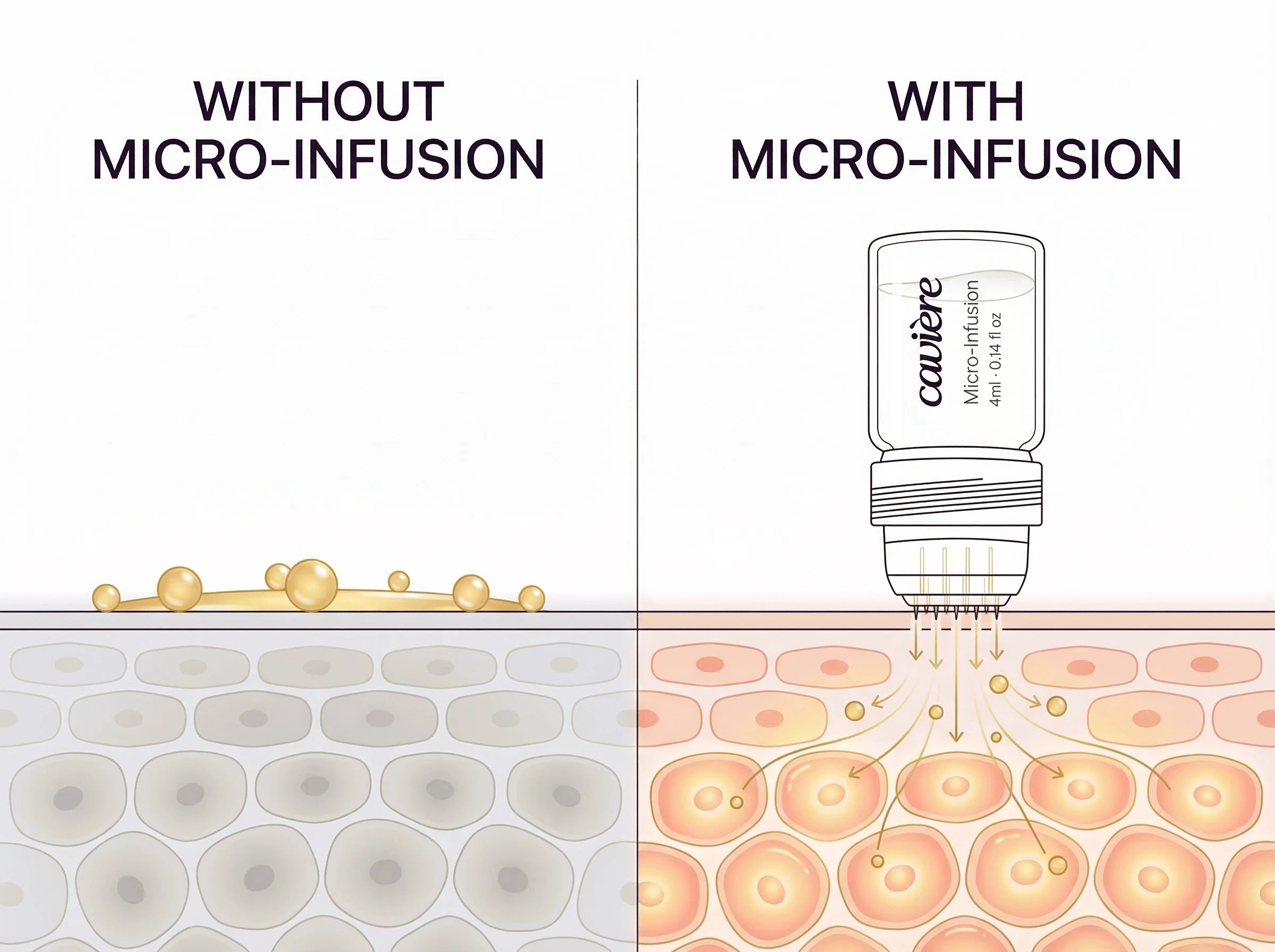
A micro-infusion device creates thousands of temporary micro-channels in the skin’s surface. These channels are microscopic, far smaller than what a needle would create, and they remain open just long enough for active ingredients to pass through the stratum corneum and reach the living epidermal and dermal cells below.
The process works in four stages:
Micro-channel creation. The device creates thousands of temporary pathways through the skin’s outer barrier. The depth is precisely controlled to avoid reaching nerve endings or blood vessels, which is why the process is painless.
Serum application. The caviar-phospholipid serum is applied to the treated area. Because phospholipids are structurally identical to human cell membranes, the serum is recognized by skin cells as biocompatible material rather than a foreign substance.
Barrier bypass. The micro-channels allow the serum to pass through the stratum corneum and reach the living cells in the epidermis and dermis. Research suggests this increases absorption by approximately 300% compared to topical application alone.
Natural channel closure. The micro-channels close within minutes as the skin’s natural repair mechanisms seal them. There is no lasting disruption to the barrier, and no recovery time is needed.
The entire process takes approximately 12 minutes and is performed once per week. Users consistently describe the sensation as similar to a gentle facial massage.

The micro-infusion device paired with the caviar-phospholipid serum.
The Cavière Micro-Infusion Facial System combines the device with caviar-derived phospholipid serums for at-home use.
Learn more about the Cavière system →What to Expect: A Realistic Timeline
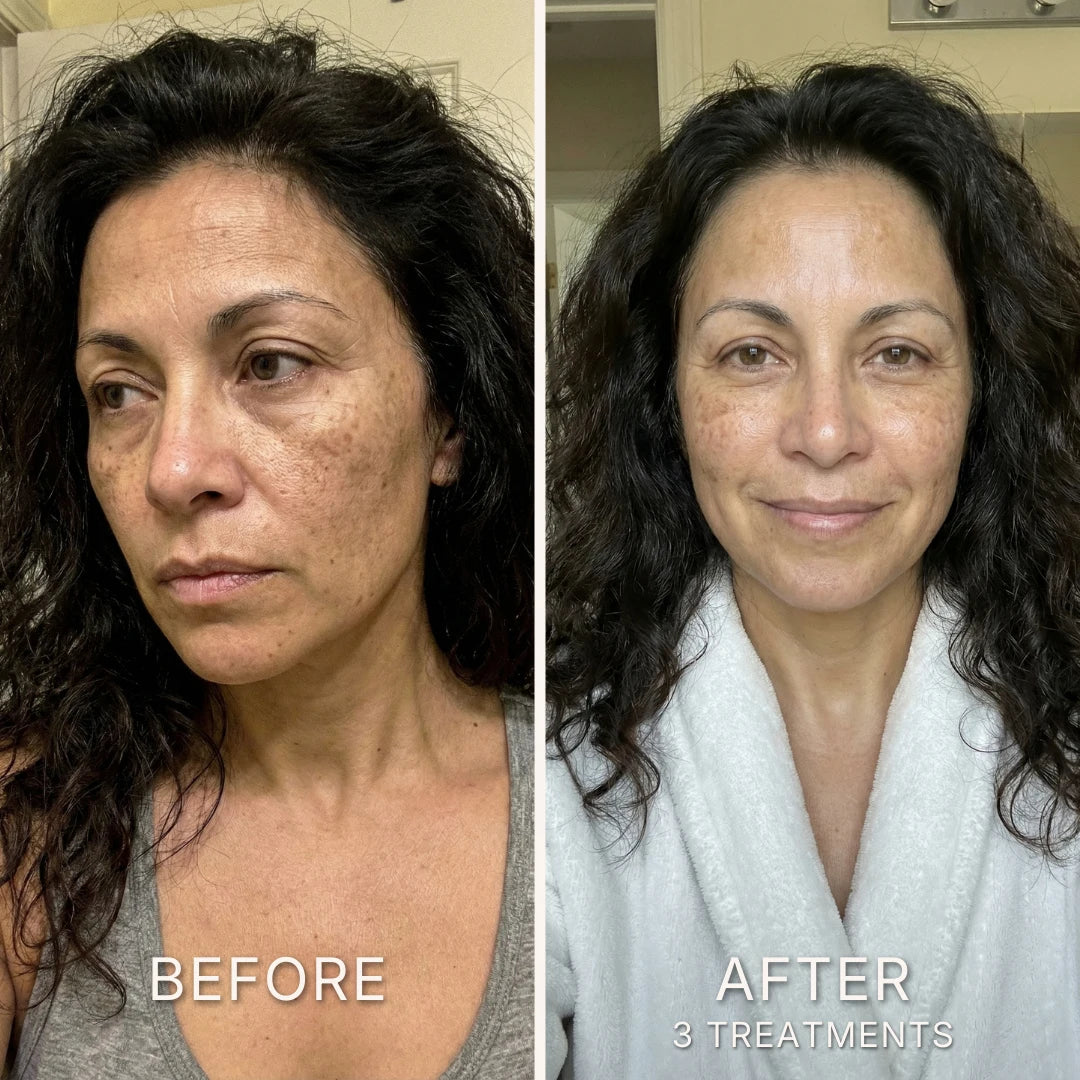
One of the most common questions about micro-infusion is how quickly results appear. Based on clinical study data and aggregated user reports, here is what the evidence suggests:
Improved skin texture and hydration. Skin feels noticeably smoother to the touch. The phospholipid serum provides immediate hydration benefits, and the micro-channels allow deeper moisture penetration than topical application alone.
Visible improvement in radiance and luminosity. Fine lines begin to soften as the deeper skin layers receive consistent nourishment. Many users report that their skin takes on a more even, healthy appearance during this phase.
Measurable improvements in elasticity and firmness. Clinical studies show 73.4% improvement in skin tightness by week 4. The DHA-adiponectin pathway is actively suppressing collagen-degrading enzymes, and the cumulative effect of consistent delivery becomes visible.
Cumulative results become pronounced. Collagen support mechanisms are at full effect. The combination of reduced degradation (via MMP-1 suppression) and enhanced cellular nourishment produces the most significant visible improvements during this period.
Individual results vary. These timelines are based on clinical study data and user reports.
Common Questions About Micro-Infusion
Is micro-infusion the same as microneedling?
No. While both technologies create micro-channels in the skin, they differ significantly in design, depth, and purpose. Microneedling uses longer needles that penetrate into the dermis, intentionally creating a wound-healing response. It can cause redness, bleeding, and requires recovery time. Micro-infusion uses much shorter, finer points that create superficial channels, just deep enough to bypass the stratum corneum without triggering an inflammatory response. The goal is ingredient delivery, not controlled injury.
Does it hurt?
No. Because the micro-channels are superficial and do not reach nerve endings or blood vessels, the sensation is painless. Users consistently describe it as feeling like a gentle massage. There is no redness, no recovery time, and no discomfort during or after the session.
How long does each session take?
Approximately 12 minutes, once per week. The protocol is designed to be simple enough to fit into any routine without requiring special preparation or aftercare.
Can I use it with my existing skincare?
The system is designed to work with Cavière’s proprietary caviar-phospholipid serum. The serum’s formulation is specifically engineered for micro-channel delivery. The phospholipid structure allows it to be recognized by skin cells as biocompatible material, which is critical for effective absorption. Using other serums through micro-channels is not recommended, as not all formulations are designed for sub-surface delivery.
What does the research actually show?
Three key studies form the evidence base: a 2024 double-blind, placebo-controlled trial in Nutrients showing 8.8% elasticity improvement; a 2023 study in In Vivo with 102 women showing 73.4% skin tightening in 4 weeks; and cellular-level research demonstrating the DHA-adiponectin-MMP-1 pathway that explains the biological mechanism. All three are published in peer-reviewed journals and used standardized measurement methods.
Cavière products are not intended to diagnose, treat, cure or prevent any disease. Results may vary. The Cavière website is for education and information purposes only and is not intended as medical advice or a substitute for medical advice.